



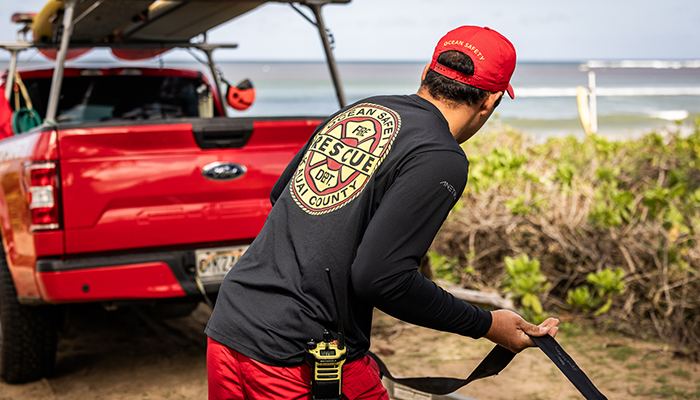

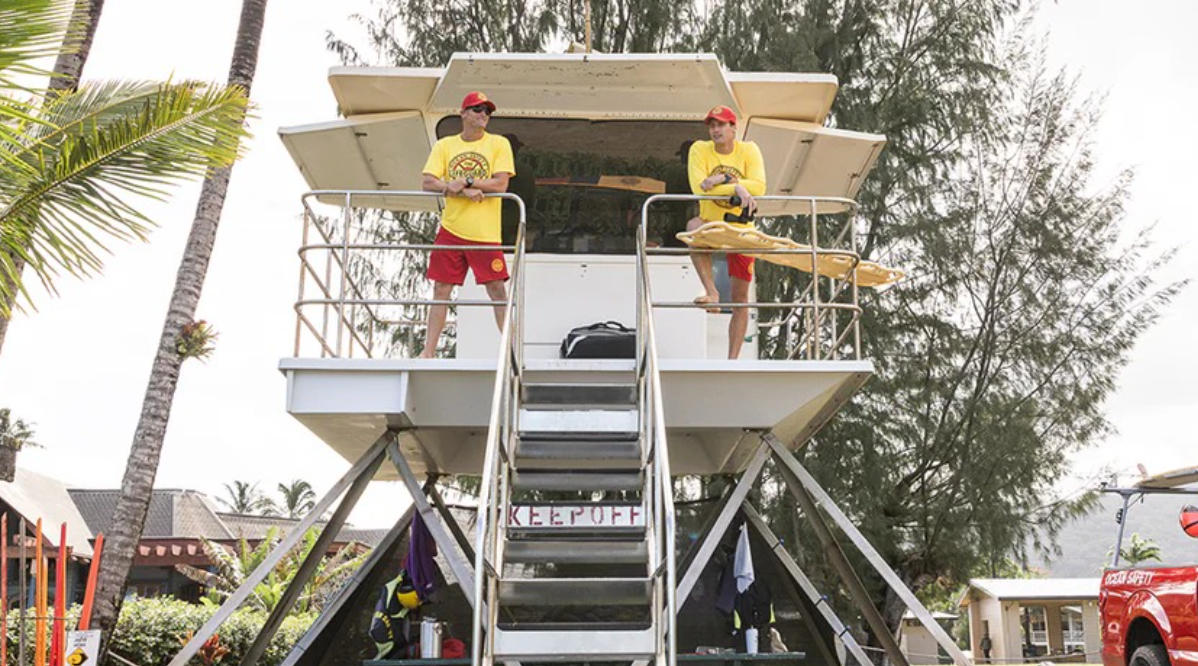
It's 10:30am on a Saturday in July. The beach is already packed. You've been on stand since 7, the sand and water are throwing heat back from every direction, and you've got six more hours in front of you. Something could change in the next thirty seconds, it might not, but it could, and your only job is to be ready when it does.
Most people look at a lifeguard and see the uniform: the red tee, the shorts, maybe a hat. What they don't see is the gear problem underneath. You're not hiking. You're not surfing a session and heading in. You're mostly stationary on one of the most reflective surfaces on earth, absorbing UV from above and below simultaneously, for a full shift, every shift, all summer.
The gear a beach lifeguard wears isn't cosmetic. It's operational. Here's what actually goes into a kit that holds up — and what it takes to get a whole staff outfitted in it.
What Do Lifeguards Wear? The Standard Kit
This is the short answer for anyone outfitting for a season — or outfitting a team. Each piece serves a specific function, and making the wrong swap on any of them costs you in ways that compound across a long shift.
- Swimwear / Board Shorts: the base layer needs full freedom of movement; board shorts that restrict hip flexion or drag when wet are a liability, not just a discomfort. Women's suits need to stay put through surf and rescue movement without readjustment. High-visibility colors (red, yellow, orange) are standard and operational: in a chaotic beach emergency, identifying the guard in the water fast is part of a controlled rescue response.
- A Long-Sleeve Performance Shirt: not optional for a full outdoor shift, and not interchangeable with a cotton tee. The shirt section below covers this in detail. It's where most of the real performance decisions happen, and it's the piece agencies most often get wrong when outfitting a staff.
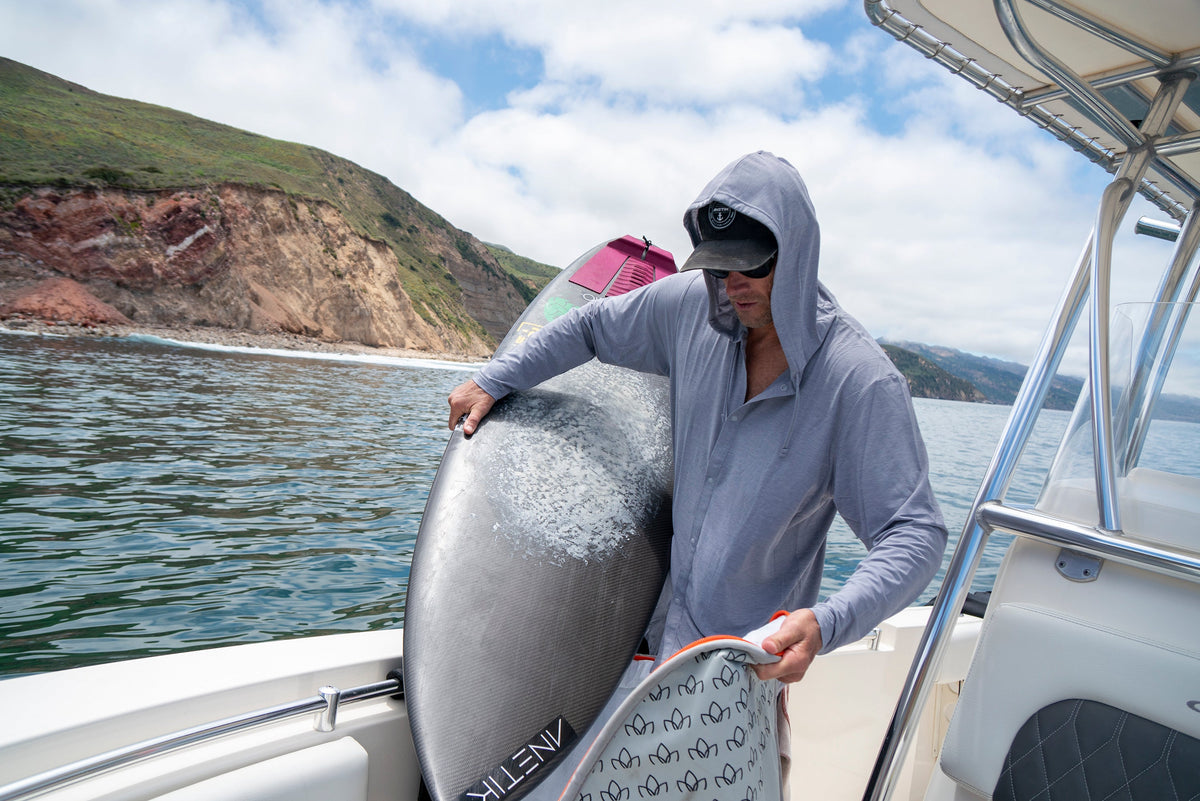
- A Hat: ears and the back of the neck are two of the most commonly missed spots in a full shift of sun exposure, easy to forget, easy to burn, and it adds up fast over a season. Pair it with one of our hooded sunshirts and the back of the neck is covered too, closing a gap sunscreen alone leaves open.
- Polarized Sunglasses with 100% UV Protection: water and sand glare doesn't just make scanning uncomfortable, it functionally impairs it. Polarized lenses are how you see what's happening 200 yards out when the sun is directly overhead. This one isn't a style preference.
- Flip-Flops: sneakers fill with water, take time to remove, and slow water entry. Flip-flops come off in one motion. When seconds matter, they matter.
- Sunscreen: the backup system, not the primary one. More on that below.
Every one of these pieces has a job. The shirt is where most lifeguards and most agencies underinvest, and where the consequences are most real.
Here's the Truth About the Lifeguard Shirt
Most shirts marketed as "lifeguard shirts" are cotton tees with a logo. That's not gear; that's a costume.
Here's the problem with cotton on a beach shift: it carries a UPF rating of roughly 5. The majority of UV radiation hitting your arms and shoulders is passing straight through to your skin, all day. But even if you swap the cotton for a high-UPF performance shirt, you've only solved half the problem.
A study measuring UV exposure among pool lifeguards at four U.S. locations found that more than 74% exceeded recommended occupational UV exposure limits — not because they weren't wearing protection, but because the protection wasn't designed for what the job actually demands. Sunscreen wears off. Cotton transmits UV. And here's what the spec sheets won't tell you: a shirt engineered for maximum UV blocking uses a denser, tighter weave — which also traps body heat.
A guard who is overheating is slower. Attention drifts. Decision-making degrades before the body consciously registers the strain. The shirt keeping your skin from burning can be the same shirt driving your core temperature up through a long shift. UV protection and thermal management are both safety variables, and the best lifeguard shirt has to address both at once.
What a Beach Lifeguard Shirt Actually Needs to Do
A shirt that earns a spot on a full outdoor shift has to do four things simultaneously. Here's the honest breakdown:
1. Block UV Without Cooking You
UPF measures how much UV radiation a fabric blocks. A UPF 30+ rating blocks roughly 97% of incoming UV rays; UPF 50 blocks about 98%. That gap is small on paper but comes with a real cost in breathability — a denser weave blocks slightly more UV but traps significantly more heat. For a two-hour surf session, that trade might be acceptable. For an eight-hour stationary shift on a hot beach, it isn't.
Our shirts are engineered around UPF 30+ as a deliberate design choice, not a shortcut. The goal is all-day wearability in extreme conditions, and that requires fabric that breathes.
2. Actively Manage Your Body Temperature
There's a difference between moisture-wicking (moving sweat away from skin) and active cooling (driving evaporation to lower skin temperature). Our VINT Cooling Technology is built around the second principle: in hot weather, body heat moves freely outward through the fabric while external airflow cycles in through it. That combination drives evaporative cooling at the skin's surface — the same mechanism your body uses to regulate itself, working with the fabric construction rather than against it.
The result isn't just comfort. A guard whose shirt is actively cooling them performs more reliably at hour seven than a guard wearing a shirt that's been accumulating heat since hour one.
3. Move With You the Moment It Matters
Long sleeves that bind at the shoulder, hold water weight, or add drag on a rescue entry are a problem. The PrimoLite® mesh construction in our performance shirts gives 360° stretch and dries fast — designed to wear wet, wear dry. When something happens in the water, the shirt should disappear from your awareness entirely.
4. Hold Up Across a Full Season
Salt, sand, repeated immersion, and sun stress fabrics differently than normal wear. A shirt that's still holding its shape and protection in October earned its place in the kit. A shirt that's degraded by July didn't — and that's a different math problem when you're the one who bought forty of them, not one.
The Right Shirt for On-Duty Beach Use
These are the shirts we'd put on a beach shift. Same PrimoLite® mesh, same VINT Cooling Technology, built for wear-wet/wear-dry use in open water and coastal environments.
- Men's: Low Pro Tech Longsleeve — Featherweight PrimoLite® mesh, VINT Cooling Technology, 4-way stretch, UPF 30+.
- Women's: Flight Tech L/S — Same core construction in an active women's fit built for all-day coverage and full range of motion.
- Surf Tee: A short-sleeve option for shifts that don't call for full long-sleeve coverage but still need UPF protection and quick-dry performance.
- Rashguard: A snug, chafe-free layer for high-movement stretches in the water, where a looser fit would drag or ride up.
- Board Shorts: Full hip mobility, no drag when wet, built for rescue movement rather than just the paddle-out.
Both move with you in the water and dry fast enough to get back to work without thinking about it.
The Layering Problem Nobody Talks About
Beach shifts often start cold and end hot. A 6am stand on the coast in June is a different climate than noon on the same beach, sometimes by 30 degrees. A guard who layers wrong spends the first three hours overheating and the last three losing the plot on what they're actually wearing.
Worth being precise here: this isn't a base layer. It's what to wear over one when the morning's cold, and it's the only layer you need once the sun's up. The Low Pro Tech Hoody works as an active second layer on the cold end of the shift, the same knit construction that manages heat in extreme sun also regulates temperature when it's cooler, moving hot air out while letting outside air in, so you're not sweating under a layer you put on to stay warm. As the temperature climbs, it keeps doing the same job it does at noon: breathing, wicking, staying dry. No swap, no second shirt, no production made out of putting it on or taking it off.
The rest of the season, on regular hot-shift days, that same construction is doing the opposite job — pulling heat off your skin instead of holding it in, which is the whole reason it works at both ends of a temperature swing.
What Sunscreen Doesn't Cover
Sunscreen is non-negotiable, but it's the backup, not the primary layer.
Sunscreen requires reapplication roughly every two hours to maintain effectiveness, and it degrades faster with water exposure. A guard tracking a full beach doesn't stop the scan on schedule to reapply behind the ears. The shirt has to handle what sunscreen can't maintain.
The right breakdown for a full outdoor shift looks like this: performance UPF shirt for arms, chest, and back; sunscreen for everything the shirt doesn't reach: face, ears, back of neck, hands. Neither one replaces the other.
Beach vs. Open Water: What Actually Changes
The gear above applies to beach and open water lifeguarding. A few distinctions worth knowing:
|
Environment |
UV exposure profile |
Top shirt priority |
Footwear |
|
Beach / sand stand |
High reflectivity from below; ambient heat buildup |
Breathability + cooling first |
Flip-flops |
|
Open water / ocean rescue |
Saltwater immersion; paddle entry/exit |
Quick-dry, 4-way stretch, secure fit |
Same |
|
Elevated stand (stationary) |
Extended exposure, low airflow around body |
Cooling technology essential |
N/A |
|
Wind-exposed post |
Variable — can feel deceptively cool while UV is high |
UPF coverage regardless of temperature |
Context-dependent |
One note worth being direct about: pool lifeguarding is a different gear problem. Chlorinated water degrades synthetic stretch fibers over time in ways that saltwater doesn't. The shirts covered in this article are built for beach and open water, not pool environments.
Outfitting a Whole Staff, Not Just Yourself
Everything above holds for one guard buying their own kit. It gets harder when you're the one responsible for outfitting an entire staff — a dozen guards, a hundred, a full season's worth of turnover — and every shirt still has to do the same job on hour seven of a shift, whether it's guard #1 or guard #60 wearing it.
That's a different problem than an individual purchase, which is why we run it separately. Through the ANETIK Premium Partners Program, agencies, teams, and departments can outfit a full lifeguard staff with the same gear covered in this article — logo screenprinted directly onto the fabric, not embroidered, not heat-transferred. Actual screenprint, built to hold up in the same salt and sun the shirt is already built for.
Orders start at 72 units total, with a minimum of 12 units per style or colorway, so a mixed order across men's and women's cuts, or a couple of different pieces, is the norm, not the exception. Turnaround runs 14–30 days from approved artwork to delivered gear, faster if you're supplying a print-ready vector file. Every logo gets reviewed on the fabric before it goes to full production, so what a director signs off on is what a staff actually gets issued.
We already supply agencies who run exactly this kind of program day to day: the Hawaiian Lifeguard Association, San Clemente Lifeguards, Miami Beach Lifeguards, and Los Angeles Lifeguards. Different coastlines, same shift math, long hours, reflective surfaces, and gear that has to survive a full season without falling apart.
If you're responsible for outfitting a beach or open-water lifeguard staff anywhere in the country, this is built for you:
Gear That Works as Hard as the Job Does
A lifeguard's job is to be ready to act in the next thirty seconds, every thirty seconds, for an entire shift. The gear that makes that possible isn't the shirt with the biggest logo or the highest UV number on the tag — it's the shirt that keeps your body regulated, your range of motion complete, and your attention where it belongs.
We built our performance shirts because people who spend their days in the sun under real pressure needed something that actually worked. Not a costume. Not a spec sheet. Gear.
Outfitting yourself? Shop our men's or women's long-sleeve performance shirts.
Outfitting a staff? Start a bulk order or logo program →
Frequently Asked Questions
What do lifeguards wear on the beach? High-visibility swimwear, a long-sleeve performance shirt for sun protection and cooling, a wide-brim hat, polarized sunglasses, and flip-flops. The shirt is where most of the real gear decisions happen.
What is the best shirt for a lifeguard? A performance long sleeve with a verified UPF rating, active breathability, quick-dry construction, and four-way stretch. Cotton tees carry a UPF of roughly 5 — they're not built for this.
Is UPF 30+ enough sun protection for a lifeguard? Yes. UPF 30+ blocks roughly 97% of UV radiation. UPF 50 blocks about 98%, a small difference on paper that comes with a real cost in breathability over an 8-hour outdoor shift.
Why do lifeguards wear red? Red is highly visible against water and sand from a distance, which matters most during an in-water rescue when others are coordinating the response. Many agencies now use yellow, orange, or blue depending on facility policy.
Can we order lifeguard apparel in bulk for our staff? Yes — through the ANETIK x Premium Partners Program, agencies and teams can bulk order with logo customization. Get in touch here →

Leave a comment
This site is protected by hCaptcha and the hCaptcha Privacy Policy and Terms of Service apply.